Why New Construction Pricing Isn't Always What It Seems
Marinell Villa September 24, 2026
Marinell Villa September 24, 2026
Shopping for a brand-new home should be simple, right?
You go to the builder’s website, choose a floor plan you like, look at the price, and decide whether it fits your budget.
Except that’s often not how new construction works.
The price you see online may be the starting point, not the price of the home you would actually want to buy. And two builders with very different advertised prices can end up surprisingly close once you account for homesite premiums, structural options, design selections and current incentives.
That’s one of the biggest reasons I recommend having your own buyer’s agent when purchasing new construction.
The builder has a sales team representing the builder. You should have someone looking at the transaction from your side of the table—someone who can investigate the numbers, compare communities and inventory, and determine what the home will really cost.
And sometimes, doing that homework can save you a substantial amount of money.
Builder websites are designed to get you interested in a community and a floor plan. They are useful research tools, but they don’t always tell the entire financial story.
You’ll commonly see language such as:
“Starting from $438,990.”
That sounds pretty definitive.
It isn’t.
“Starting from” generally means exactly that: this is where the pricing begins.
Depending on the builder and the home, you may still need to account for:
By the time you turn the advertised house into the house you actually want to live in, the final number can look very different.
And there’s another problem: builders don’t all price their homes the same way.
One builder may advertise a lower base price but charge separately for features another builder includes. One may have higher lot premiums. Another may be offering significant incentives on certain inventory homes.
So comparing the starting prices on two websites is rarely an apples-to-apples comparison.
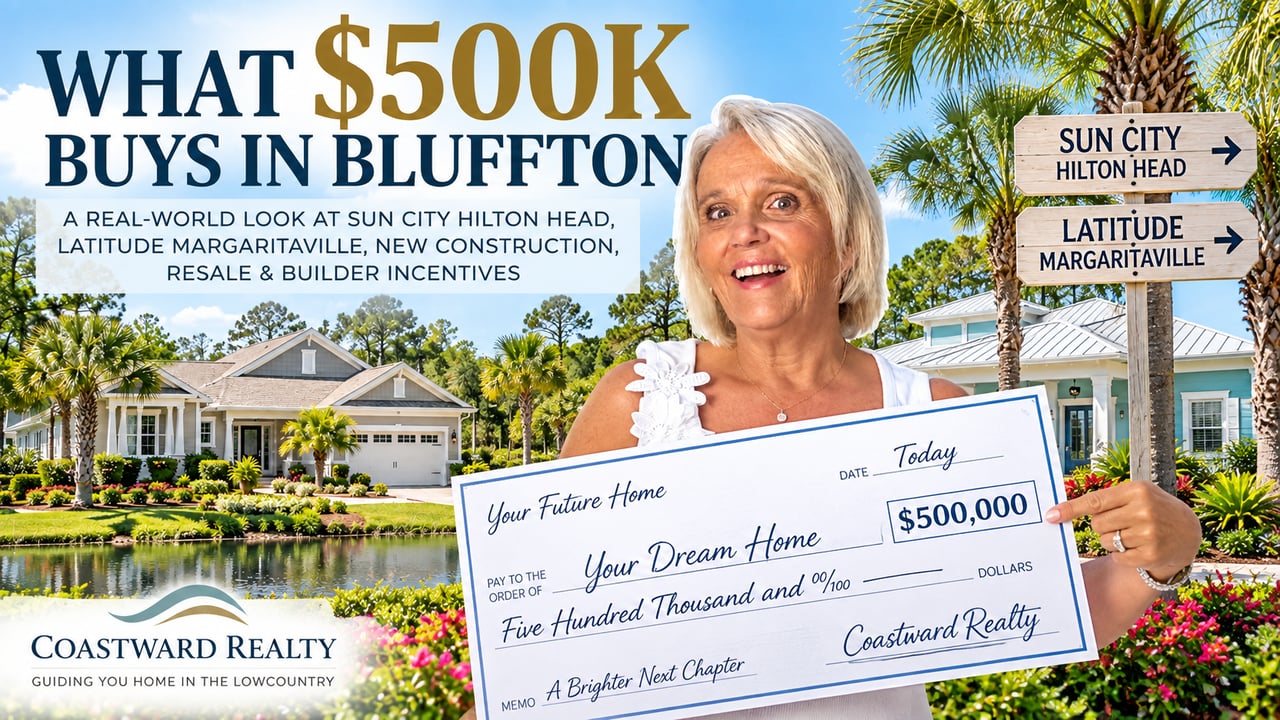
Let’s use two popular Lowcountry 55+ communities as an example: Sun City Hilton Head in Bluffton and Latitude Margaritaville Hilton Head in Hardeeville.
Suppose you have an absolute maximum budget of $500,000.
Not $525,000.
Not “maybe $550,000 if we fall in love.”
Your number is $500,000, and we need to stay as close to it as possible.
At the time I made this comparison, the Coconut at Latitude Margaritaville had an advertised starting price of approximately $438,990 for about 1,685 square feet.
The Hallmark at Sun City Hilton Head started at approximately $469,990 for about 1,581 square feet.
If we stop there, Latitude looks like the obvious value.
The Coconut is roughly 100 square feet larger and starts about $31,000 less.
Case closed?
Not even close.
To illustrate what can happen, I created a budgeting exercise using realistic assumptions based on what I see working with new-construction buyers.
These are not builder quotes, and upgrade costs, homesite premiums and incentives change constantly. But the exercise demonstrates why the starting price alone isn't enough.
Using approximately 25% plus another $5,000 for potential homesite, structural and design choices, our $438,990 Coconut comes to roughly:
$553,738
Now our “under $500,000” house is almost $54,000 over budget.
For the Hallmark, I used approximately 20% for potential additions.
Our $469,990 starting price becomes approximately:
$563,988
That puts us almost $64,000 over budget.
But notice something interesting.
The two houses started approximately $31,000 apart.
Once we estimated what it could take to finish them more realistically, that difference shrank to only about $10,250.
That’s the part you don’t necessarily see when you’re comparing builder websites from your sofa in Ohio, New Jersey or Pennsylvania.
The lower advertised price doesn't automatically mean the lower final price.
This is where having someone investigate the market can really matter.
At the same time we were looking at that Hallmark example, there was a finished quick-move-in Hallmark priced at approximately $569,230.
On paper, that's nowhere near our $500,000 budget.
Except the builder was offering a $65,000 incentive on that particular inventory home at the time.
Suddenly:
$569,230 - $65,000 = $504,230
Now we're only $4,230 away from our $500,000 target.
That is an entirely different conversation.
A buyer shopping from the builder's base-price page might have dismissed the Hallmark because its starting price was higher.
Another buyer might have built the same floor plan from scratch and spent considerably more.
But by investigating the builder's actual inventory and current incentives, we uncovered a completed home that came surprisingly close to our budget.
That is why I don't shop new construction by simply asking:
“What does this floor plan start at?”
I want to know:
What can we actually buy today, and what will it actually cost us?
Builder sales representatives can be knowledgeable, professional and extremely helpful.
But there is one important distinction buyers need to understand:
The builder's sales representative represents the builder.
If you walk into Sun City Hilton Head, the sales team is there to sell Sun City.
If you walk into Latitude Margaritaville, they're there to sell Latitude Margaritaville.
That's their job.
They aren't responsible for researching whether another community has a better opportunity for you. They aren't there to compare their inventory against resale homes throughout the area. And they aren't representing your interests in the transaction.
That's the job of your buyer's agent.
When I'm working with a new-construction buyer, I'm looking beyond one builder and one sales center.
I'm comparing things such as:
Sometimes the best choice is building from scratch.
Sometimes it's a quick-move-in.
Sometimes it's a resale where the previous owner has already spent tens of thousands of dollars on landscaping, shutters, custom closets, an extended lanai and other improvements.
The point isn't to make new construction win.
The point is to make you win.
Buyers sometimes assume that building from scratch is the best way to buy new construction.
Not necessarily.
Quick-move-in homes can be particularly interesting because much of the uncertainty has already been removed.
The homesite has been selected.
The structural decisions have been made.
The design selections are finished.
And most importantly, we know the price.
If a builder has inventory it wants sold, that home may also have an incentive attached to it.
That can create an unusual situation where a more expensive home—or even a home you originally thought was outside your budget—becomes a better financial opportunity than the lower-priced floor plan you found online.
But you have to know it's there.
There's one more comparison I always want to make.
What can we buy resale for the same money?
A resale home may already have:
The previous owner may have invested $50,000, $75,000 or even more into the home, but that doesn't necessarily mean you're paying them dollar-for-dollar for those improvements.
Of course, resale brings different questions.
How old is the roof?
How old is the HVAC?
What condition is the home in?
What will need to be replaced?
That's why the comparison isn't simply new versus resale.
It's:
What does each option give you for your money?
One of the easiest mistakes to make happens before buyers even realize they need representation.
They visit the builder first.
Depending on the community and builder, how and when your agent is introduced or registered can affect buyer representation.
So if you're thinking about new construction—even if you're “just looking”—talk to your buyer's agent before your first visit or online registration.
We can explain the process, research the communities, identify current inventory and incentives, and go into the sales center already knowing what questions we need answered.
That's a very different experience from walking in, falling in love with a model home and trying to figure out the numbers afterward.
I wouldn't say builder websites are necessarily giving you incorrect information.
The advertised base price may be perfectly accurate.
The problem is what buyers naturally assume that number means.
A home that “starts at $438,990” is not necessarily a home you can buy the way you want it for $438,990.
And a home listed at $569,230 isn't necessarily going to cost you $569,230 if there's a substantial incentive attached to it.
Those are two very different examples of the same problem:
The number you see first may not be the number that matters most.
This is the part of new construction I actually enjoy.
I don't want to simply take you to a model home and ask which kitchen you like.
I want to investigate.
What's sitting in inventory?
Which homes have incentives?
What's been reduced?
What does the builder need to sell?
How does the quick-move-in compare with building the same floor plan?
What's included with one builder that costs extra with another?
What could we buy resale for the same amount?
And most importantly:
What is the smartest way to get as much of what you want as possible without blowing your budget?
Sometimes that research confirms that the house you found online really is the right choice.
Sometimes it sends us in a completely different direction.
And sometimes it uncovers tens of thousands of dollars in potential savings or value that weren't obvious when you started searching.
If you're considering Sun City Hilton Head, Latitude Margaritaville Hilton Head, Four Seasons Carolina Oaks or another new-construction community in the Bluffton and Hilton Head area, don't start by asking which builder has the lowest advertised price.
Start with your real budget and what matters most to you.
Then let's compare the whole market.
We'll look at new construction, quick-move-ins, builder incentives and resale homes side by side—and determine what your money can actually buy.
And if you're planning a visit, contact us before you register with or visit the builder so we can make sure you understand the representation process from the beginning.
Because when you're spending $400,000, $500,000 or considerably more on a home, you deserve more information than a “starting at” price on a website.
Frequently Asked Questions
Yes, there can be new-construction and resale opportunities below $500,000, depending on the community, floor plan, homesite, available inventory and current incentives. Buyers should compare the finished purchase price rather than relying only on advertised base prices.
Depending on current inventory, buyers may find both resale and new-construction opportunities in Sun City Hilton Head around or below $500,000. Availability changes constantly, so the best strategy is to compare current resale inventory with new-construction floor plans and quick move-ins at the time you're ready to buy.
Potentially. The key is leaving enough room for the homesite, structural options and design selections. Smaller floor plans, attached homes and incentivized quick-move-in inventory can provide more opportunities.
No. Latitude Margaritaville Hilton Head is located in Hardeeville, South Carolina, near Bluffton and Hilton Head. It is frequently compared with Bluffton-area 55+ communities because buyers relocating to this part of the Lowcountry often consider both Latitude Margaritaville and Sun City Hilton Head.
Not always. A resale may provide more square footage or existing upgrades for the money, while a builder may heavily incentivize a quick-move-in home. The better value depends on current inventory, condition, location, upgrades and incentives.
No. Incentives can change frequently and may apply only to certain inventory homes, financing programs, closing costs or specific purchase conditions. Always verify the current offer before making a buying decision.
If you're researching 55+ communities in Bluffton SC and wondering whether $400,000, $500,000 or another number is enough for the lifestyle you want, start with the budget you actually want to stay within.
Then we can compare new construction, resale, builder incentives and communities side by side.
Browse homes for sale in the Bluffton area or contact Coastward Realty and tell us what you want your budget to accomplish.
And yes—if you really want to hand me a $500,000 check, I'll happily go shopping with you.

55+
Discover how Bluffton’s Lowcountry location puts beaches, historic cities, Florida getaways, and even the Blue Ridge foothills within easy road-trip reach.
What to Look Beyond the Pretty Kitchen—From Homesites and Insurance to Maintenance, Location, and Resale Value
A Real-World Look at Sun City Hilton Head, Latitude Margaritaville, New Construction, Resale & Builder Incentives

Relocation
A candid look at the lifestyle, homes, walkability, costs, and everyday realities of living in one of Bluffton’s most charming—and misunderstood—areas.

55+
Comparing lifestyle, housing, beaches, amenities and everyday living to help you decide which Lowcountry area fits you best.

55+
From Southpoint and Buc-ee’s to Latitude Margaritaville, Carolina Station, Sun City and major road improvements, here’s what buyers need to know about Hardeeville SC g… Read more

Bluffton Communities
Discover lakefront, 55+, resort-inspired, and traditional Bluffton-area neighborhoods where lifestyle—not golf—takes center stage.

55+
What housing, HOA fees, insurance, taxes, utilities, and everyday Lowcountry living really mean for your monthly budget.
55+
An in depth look at Sun City Hilton Head and Latitude Margaritaville Hilton Head
Whether you’re buying, selling, or growing your career in real estate, Coastward Realty is here to guide you. We bring local knowledge, personalized service, and a client-first approach to every step of the journey.